Watch First, Ask Later: How the Japanese Senpai-Kohai Tradition Is Changing the Way Americans Teach Each Other
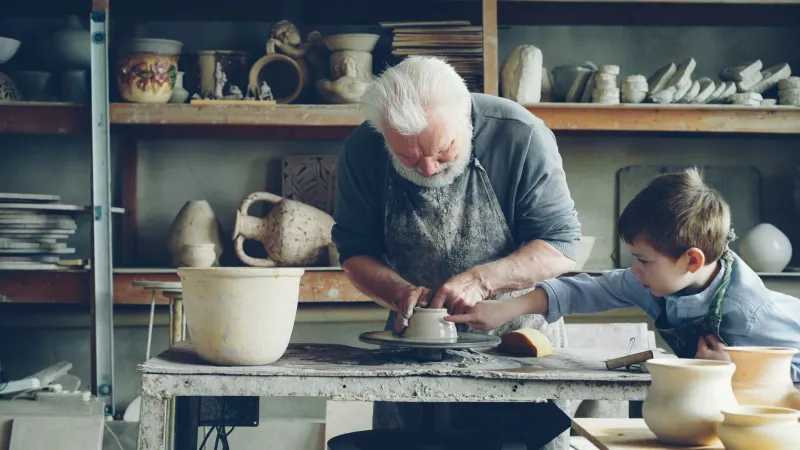
There's a moment that Kenji Watanabe, a ceramics instructor based in Portland, Oregon, describes as the turning point in his teaching philosophy. A new student — eager, well-meaning, armed with a notebook — walked into his studio and immediately asked: How do I center the clay?
Kenji didn't answer right away. Instead, he sat down at the wheel, threw a bowl in silence, and let the student watch. Then he nodded toward the empty seat beside him.
"I realized I'd been teaching the Western way my whole career," Kenji says. "Step one, step two, here's the handout. But that's not how I actually learned. I learned by watching my teacher for weeks before I ever touched the clay."
What Kenji was reaching back toward has a name in Japanese: senpai-kohai. And it turns out, more Americans than you might expect are reaching toward it too.
What Senpai-Kohai Actually Means
The terms are simple enough to translate. Senpai refers to someone with more experience — a senior, a guide, someone who has walked the path before you. Kohai is the newcomer, the one who follows. But the relationship between them is far richer than those labels suggest.
Unlike Western mentorship, which often looks like scheduled meetings, goal-setting worksheets, and structured feedback sessions, senpai-kohai is ambient. It lives in the everyday fabric of a shared environment. The kohai observes how the senpai moves through the world — how they handle a difficult customer, how they speak to an elder, how they approach a problem they haven't solved before. Learning happens through proximity, not curriculum.
There's also a reciprocal quality that surprises many Americans when they first encounter it. The senpai doesn't just give; they're expected to grow through the act of guiding. And the kohai doesn't just receive — they bring a fresh perspective that quietly challenges the senpai to articulate things they'd long taken for granted.
"You don't really understand something until you have to show it to someone who's never seen it," says Yuki Tanaka, a community organizer in Los Angeles who runs a Japanese American youth mentorship program. "That's built into the senpai role. You're not just passing down knowledge. You're refining your own."
Why American Culture Is Hungry for This
American professional culture has never been short on mentorship programs. Corporate onboarding, peer coaching, LinkedIn connections with subject-matter experts — the machinery is everywhere. But a lot of people will tell you, quietly, that it often feels hollow.
Part of the problem is pace. American mentorship tends to be transactional and time-bound. You get thirty minutes with someone impressive, you take notes, you send a thank-you email, and you move on. There's not much room for the kind of slow, observational learning that senpai-kohai requires.
Another issue is the cultural discomfort with hierarchy. Americans tend to flatten relationships fast — first names on day one, "my door is always open" from the boss, the insistence that everyone's opinion is equally valid regardless of experience. That's not all bad. But it can strip away something useful: the acknowledgment that some people genuinely know more, and that watching them closely — respectfully, patiently — is a legitimate form of learning.
"We've been told that asking questions is a sign of engagement," says Marcus Reid, a software developer in Austin who began studying kendo three years ago and credits the dojo's senpai-kohai structure with reshaping how he approaches onboarding junior engineers. "But sometimes the better question is: can I just watch you do that for a while?"
What It Looks Like in Practice
At the dojo where Marcus trains, newer students don't just drill techniques alongside senior practitioners. They're expected to observe, to help with the setup of the space, to notice how experienced kendoka carry themselves even when they're not actively practicing. The learning isn't confined to the hour of formal instruction.
Marcus brought a version of this back to his team. When a new engineer joins, he doesn't hand them a task list. He invites them to shadow him through a full work cycle first — sitting in on meetings, watching him debug code, listening to how he talks through a problem out loud. Only after a week or two does the new hire start taking on their own assignments.
"The feedback I get is that people feel less anxious," he says. "They're not thrown in and expected to perform immediately. They get to understand the culture of how we work before they have to participate in it."
Similar adaptations are showing up in creative communities. At a Japanese American community arts center in San Jose, printmaking classes are structured so that newer participants spend their first session simply watching — not touching the press, not mixing ink. Just observing how a more experienced artist moves through the process. Instructors there say it reduces waste, cuts down on frustration, and produces students who are more confident when they do pick up the tools.
Patience as a Radical Act
Maybe the most countercultural thing about senpai-kohai, at least by American standards, is its relationship with time. There's no shortcut. The kohai can't rush to the front of the line just because they're motivated or talented. The senpai can't hand over a PDF and call it a day. Both parties have to be present, consistently, over a long stretch.
In a culture obsessed with acceleration — fast learning, life hacks, ten-minute masterclasses — that kind of patience can feel almost radical.
But the people who've tried it say the slowness is the point.
"I think Americans are tired," says Yuki Tanaka. "Tired of feeling like they have to figure everything out alone, tired of mentorships that feel like networking in disguise. There's something about this model that gives people permission to actually be a beginner. And permission to actually be a teacher. Not a content creator. Not a thought leader. Just someone who knows things and cares enough to share them properly."
Kenji Watanabe puts it even simpler. After that first wordless demonstration, his student sat down at the wheel. Didn't ask any questions. Just started to feel the clay.
"By the end of the session," Kenji says, "they'd figured out more than I could have explained."
There's a lesson in that, if you're patient enough to wait for it.