Hit Something Together: Why Taiko Drumming Is Building the Communities Americans Didn't Know They Were Missing
Hit Something Together: Why Taiko Drumming Is Building the Communities Americans Didn't Know They Were Missing
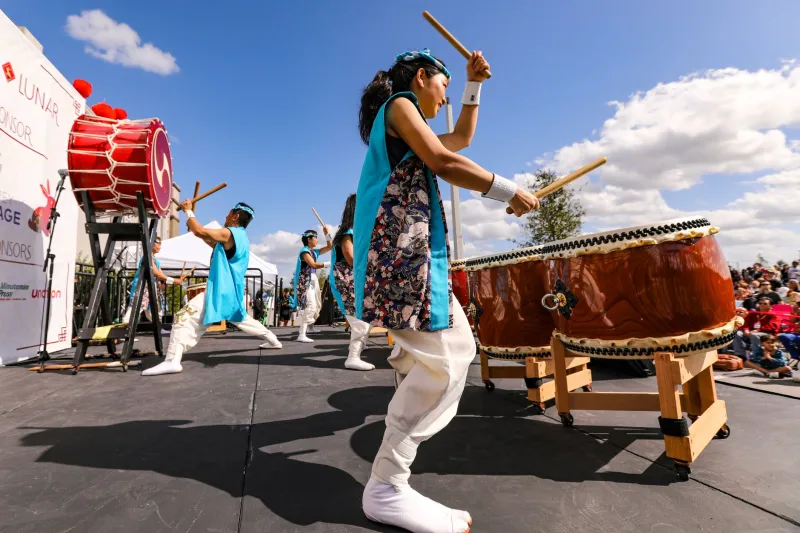
There's a moment that almost every new taiko student describes the same way. You're standing in front of a drum that's bigger than your torso, bachi sticks in hand, and someone counts you in. You strike. The sound doesn't just leave the drum — it moves through your chest, your arms, the floor beneath your feet. And then the person next to you strikes, and the person next to them, and suddenly you're not just making noise. You're part of something.
That feeling is hard to manufacture. Taiko doesn't let you fake it.
Louder Than Loneliness
American life has gotten quieter in all the wrong ways. Fewer front-porch conversations, fewer third places, fewer reasons to show up somewhere regularly and stand next to a stranger. We've built elaborate digital lives that technically connect us to thousands of people while somehow leaving us more isolated than ever.
Taiko, the centuries-old Japanese tradition of ensemble drumming, is a direct counter-force to all of that. It is, by its very nature, a group activity. There are no taiko soloists sitting alone in a practice room. The music only exists when multiple people are playing it together, responding to each other's energy, locking into a shared rhythm that none of them could sustain alone.
That's not a feature of taiko. That's the whole point.
Groups like Chicago Taiko and San Jose Taiko — one of the oldest taiko organizations in North America — have been demonstrating this for decades. But what's striking right now is how many new ensembles are forming in places you wouldn't expect: mid-sized Midwestern cities, suburban community centers in the Southeast, university rec halls in the Pacific Northwest. And the people joining them? Often no Japanese heritage, no drumming background, no particular reason to be there except a vague sense that they need exactly this.
The Rehearsal Room as a Third Place
Walk into a taiko rehearsal and you'll notice a few things immediately. First, yes, it's loud. Second, everyone is sweating. Taiko is a full-body workout — you're not just using your wrists, you're driving power from your legs, your core, your whole stance. Third, and most importantly, nobody is on their phone.
You can't be. The music requires your entire attention, and the group requires your presence. If you zone out, the rhythm falls apart. If you hold back, the ensemble feels it. There's a kind of radical accountability built into every practice session that has nothing to do with rules and everything to do with sound.
For a lot of participants, this is the first time in years — sometimes decades — that they've been in a room where showing up fully was genuinely required of them.
"I've tried yoga, I've tried running clubs, I've tried all of it," one member of a taiko group based in the Denver metro area explained. "Nothing made me feel like I was actually needed somewhere until this. If I don't come to practice, they notice. Not in a guilt-trip way. Just — the drum line has a hole in it."
That sense of being genuinely necessary to something larger than yourself is rarer than it should be. Taiko delivers it, rehearsal after rehearsal.
No Background Required (Seriously)
One of the most consistent things you hear from taiko instructors across the country is that musical experience is almost beside the point. Rhythm helps, sure. But taiko technique is taught physically and aurally — you learn by watching, by listening, by doing. The body figures it out before the brain does.
This makes taiko unusually accessible as a cultural entry point. You don't need years of classical training. You don't need to read music. You need to be willing to look a little ridiculous at first, which, it turns out, is a surprisingly effective social leveler. When everyone in the room is struggling with the same footwork pattern, the usual social hierarchies tend to dissolve pretty quickly.
Groups that have been intentional about welcoming beginners — like those affiliated with the Taiko Community Alliance, which supports ensembles across North America — often describe their membership as genuinely diverse in ways that feel organic rather than performed. People from different neighborhoods, different backgrounds, different generations, all standing in the same sweaty room trying to nail the same sequence of strikes.
What the Japanese Tradition Actually Carries
It's worth pausing here to acknowledge what taiko is, beyond the workout and the community-building. This is a living Japanese cultural tradition with deep roots in Shinto ritual, Buddhist ceremony, and the rhythms of agricultural life. The sounds that American beginners are learning to produce have been moving through Japanese communities for centuries.
Many taiko groups in the US are thoughtful about this context. Instructors — particularly those trained in Japan or by Japanese American masters — often weave cultural history into the teaching. Students learn not just the technique but the meaning: why certain rhythms exist, what occasions they were played for, how taiko was carried across the Pacific by Japanese immigrants and kept alive through generations of Japanese American communities, including during some of the hardest chapters of that history.
For non-Japanese participants, this adds a layer of depth that makes the practice feel like more than just exercise or social activity. It's an invitation into a tradition that has survived and meant something. Treating it with that kind of respect seems to be part of what makes these communities function as well as they do.
The Sound That Stays With You
Ask anyone who's been playing taiko for more than a few months when they started to feel like part of the group. Almost nobody says it was at a performance, or at a social event after rehearsal. They say it was somewhere in the middle of a practice — a moment when the rhythm clicked, when they stopped thinking about what their hands were doing and just played, and the sound of the group wrapped around them like something solid.
That's not a metaphor. That's the acoustic reality of a taiko ensemble at full volume. The sound is physical. It occupies space. It occupies you.
In a culture that often struggles to give people reasons to be in the same room, doing the same thing, needing each other — taiko is offering something genuinely hard to replicate. Not just a hobby, not just a class, but a rhythm that requires a crowd to exist at all.
The drum draws people in. What keeps them there is each other.