Wrap It Different: How Furoshiki Is Changing the Way Americans Give — and What They Give Away
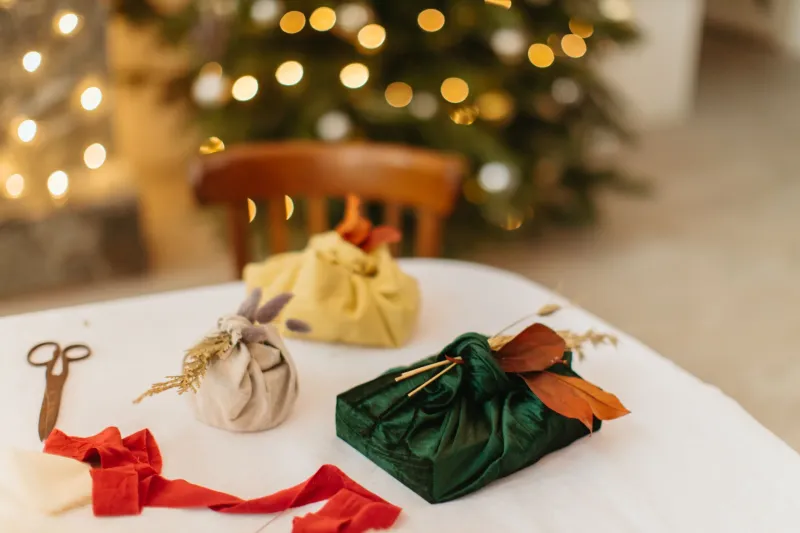
Every December, Americans throw away roughly 4.6 million pounds of wrapping paper and shopping bags. Most of it lands in a landfill before the leftovers are even packed away. It's a statistic that's easy to gloss over — until you watch someone spend forty-five minutes carefully folding a square of indigo-dyed cotton around a bottle of wine, tying it into a neat carry handle, and handing it across a table like it's already the gift itself.
That's furoshiki. And once you see it done well, disposable wrapping paper starts to feel a little absurd.
An Old Idea Finding a New Audience
Furoshiki (pronounced foo-ROH-shee-kee) has been part of Japanese daily life for centuries. Originally used to carry clothes to public bathhouses, the square cloth eventually became a universal bundling tool — for groceries, gifts, books, and just about anything else that needed transporting with dignity. The name itself loosely translates to "bath spread," a nod to those early practical roots.
The cloth never disappeared in Japan, but it did fade into the background as plastic bags and glossy gift wrap took over. A government-led sustainability push in the mid-2000s brought it back into the spotlight, and somewhere along the way, the idea crossed the Pacific.
Now, furoshiki is showing up at Japanese American cultural centers, zero-waste pop-ups, holiday craft workshops, and corporate team-building events from Seattle to Atlanta. The people adopting it aren't just sustainability advocates — they're people who stumbled into a workshop, watched a fold demonstrated once, and quietly thought: I want to do that.
What the Cloth Actually Carries
To understand why furoshiki resonates beyond its obvious eco-appeal, it helps to look at what the cloth itself communicates.
Traditional furoshiki fabric isn't plain. It's often printed with seasonal motifs — cranes, chrysanthemums, waves, maple leaves — each carrying its own layer of meaning. A cloth printed with pine and bamboo suggests resilience and longevity. One patterned with flowing water evokes adaptability. Choosing a cloth for a specific person or occasion is itself a form of thoughtfulness that disposable wrapping paper simply can't replicate.
The folds matter too. There are dozens of recognized wrapping styles, each suited to a different object or purpose. The otsukai tsutsumi is a classic flat wrap for boxes. The bin tsutsumi cradles a bottle elegantly. The suika tsutsumi — literally the "watermelon wrap" — bundles round objects into something that looks almost sculptural. Learning even three or four of these feels less like a craft skill and more like a small vocabulary, a way of saying something without words.
"It made me slow down," says Renata, a graphic designer in Portland who first encountered furoshiki at a Japanese American community event two years ago. "When I'm wrapping something for someone now, I'm actually thinking about them the whole time. What cloth suits them? What fold fits this shape? It turns the wrapping into part of the gift."
Where Americans Are Learning
Community organizations have been central to furoshiki's spread in the US. Japanese American cultural centers in cities like Los Angeles, San Francisco, Chicago, and Honolulu have hosted wrapping workshops for years — often tied to holiday seasons or sustainability programming. But the practice has also migrated online in a significant way, with YouTube tutorials and Instagram reels making it accessible to anyone with a square of fabric and twenty minutes.
What's interesting is where the workshops are landing now. Corporate wellness coordinators are booking furoshiki sessions as team events. Public libraries are hosting them as part of zero-waste programming. Bridal showers and baby showers have started incorporating them as a way to make the whole unwrapping experience feel more intentional.
Dana, who coordinates cultural programming at a community center in the Bay Area, has watched attendance at furoshiki workshops nearly double over the past three years. "People come for the sustainability angle, but they stay because it's genuinely meditative," she says. "There's something about working with your hands, getting the tension right in a fold, that quiets the noise. And then you have this beautiful thing at the end that someone else gets to keep."
That last part — the fact that the wrapping itself becomes a second gift — seems to be one of furoshiki's most compelling hooks for American audiences.
A Different Kind of Unboxing
American gift culture is, by and large, built around abundance and speed. Tear it open, move to the next one. The wrapping is incidental — a means to an end, a moment of suspense before the real thing is revealed.
Furoshiki inverts that. The cloth slows the opening down. Recipients often pause before unwrapping, turning the bundle over, admiring the pattern or the knot. Some people don't want to undo it at all. And that's kind of the point — the care embedded in the wrapping is visible before a single fold is loosened.
For Japanese American communities, this resonates on a cultural level that goes beyond trend. Furoshiki is part of a broader aesthetic sensibility — one that values process alongside product, presentation as an extension of respect. Giving something wrapped in furoshiki is, in that tradition, a way of saying: I thought about this. I thought about you.
That message lands across cultural lines, it turns out.
Getting Started Without Overthinking It
One of furoshiki's genuine appeals is its low barrier to entry. You don't need a special kit or expensive supplies. A square of fabric — even a bandana, a dish towel, or a remnant from a fabric store — works perfectly well for a first attempt. Traditional furoshiki cloth is typically 45 to 70 centimeters square, but the technique scales up or down depending on what you're wrapping.
For anyone curious, community workshops remain the best first step. Organizations like Kouenkai and similar Japanese cultural groups regularly host beginner sessions where you can learn a few core folds, handle different fabric weights, and ask questions in real time. Online tutorials are plentiful, but something about learning it alongside other people — fumbling through the first knot together, laughing when the bottle tips sideways — makes it stick differently.
Once you've got two or three folds down, the practice tends to take on its own momentum. People start collecting cloth. They start thinking differently about what they wrap and why. They start noticing how much plastic they used to use without a second thought.
Small Ritual, Bigger Shift
Furoshiki won't single-handedly solve the waste problem embedded in American consumer culture. But that's not really the point. What it does — quietly, reliably — is introduce a moment of intentionality into an act that's usually rushed and reflexive.
And in doing that, it asks a question worth sitting with: What does it mean to give something well?
Not just the right thing, but the right way. With attention. With cloth chosen to suit the person. With folds that took a few minutes and a little care.
That's a question Japanese culture has been answering for centuries. Americans, it turns out, are ready to start learning the answer.