Stop Thinking, Start Being: How Mushin Is Helping Overwhelmed Americans Get Out of Their Own Way
There's a particular kind of exhaustion that doesn't come from doing too much. It comes from thinking too much about what you're doing while you're doing it. Americans know this feeling well. We narrate our own lives in real time, second-guess every email before hitting send, replay conversations in the shower, and spend half of any given meeting wondering if we're saying the right things. We are, by most accounts, a culture that is deeply, chronically inside its own head.
Which is part of why a concept from Japanese martial arts — one that's been around for centuries — is starting to resonate far beyond the dojo.
What Mushin Actually Means
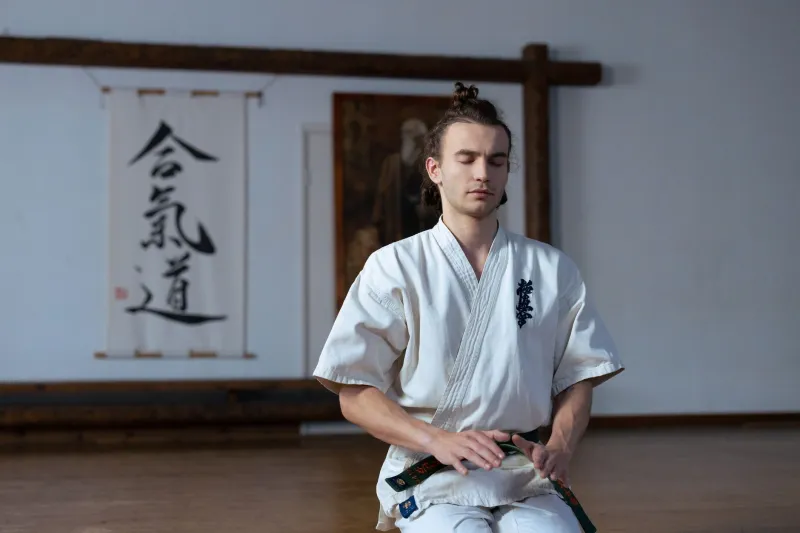
Mushin, often translated as "mind without mind" or "no mind," is a mental state that martial artists train toward over years of practice. In a fight or a sparring match, there's no time to consciously process every decision. The practitioner who stops to think is the one who gets hit. Mushin describes the state where action flows from training and instinct rather than deliberate thought — where the body moves because it knows how, not because the brain gave it permission.
But the concept doesn't stop at physical practice. Rooted in Zen Buddhism and Taoist philosophy, mushin is also about releasing attachment to outcomes, fears, and the constant mental chatter that clouds perception. It's presence without agenda. Awareness without anxiety.
For Americans who've spent years being told to optimize, plan, and reflect on everything, this idea can feel almost radical.
When Overthinking Becomes the Problem
Ask any therapist in a major American city what their clients are struggling with, and analysis paralysis comes up constantly. People know what they want to say in a difficult conversation — they've rehearsed it a hundred times — but when the moment comes, they freeze or overcorrect. Professionals with years of experience second-guess decisions that should be instinctive by now. Couples who love each other can't stop performing for each other long enough to actually connect.
The irony is that the more we try to think our way to the right outcome, the further we get from it. Constant mental narration creates distance — between us and our work, between us and other people, between us and whatever we actually feel.
This is where communities engaging with Japanese culture across the U.S. are finding something genuinely useful. At martial arts schools and cultural centers from Seattle to Atlanta, instructors who teach kendo, aikido, and judo are starting to hear from students who came not for the fighting technique but for the mental training underneath it. People want to know how to quiet the voice that won't stop commenting on everything.
What It Looks Like in Practice
At a kendo dojo in the Chicago area, the instructor — who has been teaching for over two decades — describes a familiar pattern. New students come in overthinking every movement. They want to understand the logic of each strike before committing to it. "I tell them," he says, "the understanding comes after the doing, not before. You have to let the body learn."
That inversion — acting before fully understanding — runs against a lot of American instincts around productivity and self-improvement. We're trained to plan first, execute second. But mushin asks for something different: trust. Trust in your training, your instincts, your accumulated experience. And trust that not every moment needs to be managed.
Some workplaces are starting to explore this in their own way. Certain design and tech teams in cities like San Francisco and Austin have started experimenting with what they informally call "no-analysis sprints" — short creative sessions where the rule is to generate without evaluating. No one is explicitly calling it mushin, but the underlying logic is the same: get the thinking mind out of the way long enough to let something real surface.
Relationships Are Where It Gets Complicated
Bringing mushin into personal relationships is trickier, and arguably more important. So much of what goes wrong between people happens because someone is too busy managing the interaction to actually be in it. We're crafting our next response while the other person is still talking. We're monitoring tone, subtext, and optics instead of just listening.
People who've studied Japanese cultural practices — particularly those rooted in Zen-influenced traditions — often note that presence is treated as a form of respect. To be fully with someone, without distraction or performance, is to honor them. That's a different frame than most Americans are working with.
Some relationship counselors in the U.S. are incorporating presence-based practices into their work — not always using the word mushin, but drawing on the same principles. The goal isn't to stop thinking altogether. It's to stop letting thinking become a wall between you and the person in front of you.
The Learning Curve Is Real
None of this is easy, and it's worth being honest about that. Mushin isn't a hack or a shortcut. In traditional martial arts, it emerges from years of disciplined repetition. You don't arrive at "no mind" by deciding to stop thinking. You arrive there by training so thoroughly that thinking becomes unnecessary.
For Americans engaging with this concept outside of martial arts — in creative work, in conversation, in leadership — the equivalent is building enough genuine competence and self-trust that the inner critic starts to quiet down on its own. That takes time. It takes failure. It takes a willingness to act before you're certain.
But communities across the country that have been sitting with Japanese cultural traditions for a while will tell you: the discomfort of not knowing is something you can learn to tolerate. And on the other side of that discomfort is something that feels, for a lot of people, like relief.
A Different Kind of Presence
What mushin offers isn't emptiness for its own sake. It's clarity. A mind that isn't cluttered with self-monitoring has more room for what's actually happening — the real problem, the real person, the real moment. For a culture that has mistaken busyness for aliveness and overthinking for intelligence, that kind of clarity isn't just appealing. It might be necessary.
You don't have to earn a black belt to start exploring it. You just have to be willing, for a moment, to stop narrating and start showing up.