Let It Be Slow: What American Audiences Are Learning by Sitting Through Japanese Theater Without Trying to Understand It
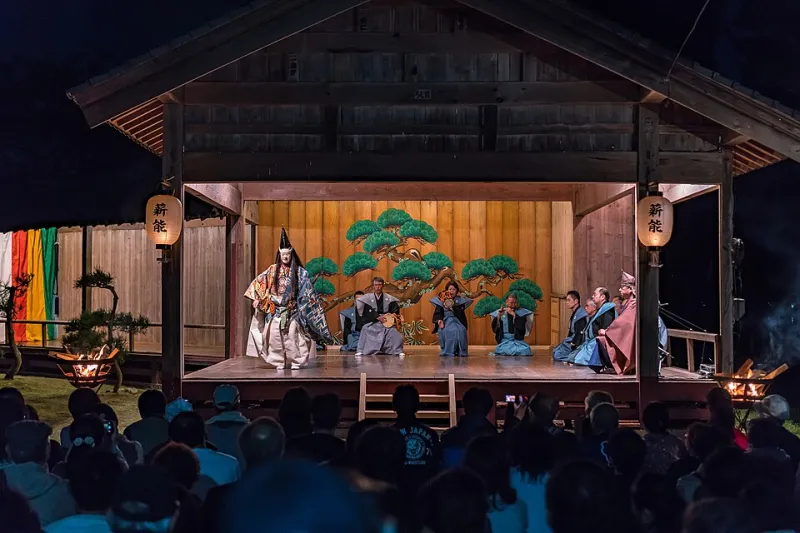
Photo: Yoshiyuki Ito, CC BY-SA 3.0, via Wikimedia Commons
About twenty minutes into a noh performance, something happens to the part of your brain that wants to know what's going on. It gets tired. It gives up. And then, if you're lucky, something else takes over.
This is the experience that a growing number of Americans are seeking out at Japanese theater events—not because they're experts in classical Japanese arts, but precisely because they're not. They're showing up to be confused. To be slowed down. To practice, in a formal and slightly uncomfortable setting, the art of not needing to understand everything immediately.
In a culture that prizes comprehension, efficiency, and the quick take, this is a more radical act than it sounds.
The Problem with Needing to Get It
American audiences are, generally speaking, very good at consuming art that explains itself. Hollywood has refined over a century the craft of making meaning instantly legible: the swelling score that tells you how to feel, the expository dialogue that makes sure you're not confused, the editing rhythms that keep attention from wandering. Streaming platforms A/B test thumbnails and opening sequences to minimize the chance that you'll disengage before the story hooks you.
None of this is inherently bad. But it trains us to be passive in a particular way—to expect art to do all the work. And when art doesn't do that work, when it asks us to sit with ambiguity, to let meaning accumulate slowly, to tolerate not knowing—we often experience it as failure. The art failed us. Or we failed the art.
Japanese theatrical traditions like noh, butoh, and even the stylized puppet theater of bunraku operate from an entirely different premise. They're not trying to make comprehension easy. They're creating conditions for a different kind of experience altogether—one that requires the audience to bring something to the room rather than just receive what's served.
What Noh Actually Does to You
Noh is one of the world's oldest surviving theatrical traditions, dating to 14th-century Japan. It is extraordinarily slow. Performers move in ways that can seem almost geological—a single step taking what feels like minutes, a gesture unfolding over an interval that challenges Western notions of stage time. The masks worn by lead performers are carved to appear neutral, yet shift in expression depending on the angle of light and the tilt of the performer's head. The music is chanted rather than melodic in any Western sense.
The first time most Americans see noh, their instinct is to figure it out. What is the story? Who are these characters? What does that gesture mean? The program notes help, but only so much. Because noh isn't primarily a narrative experience—it's a temporal one. It's asking you to inhabit a particular quality of time, to feel the weight of a moment stretched almost past bearing, and to find something inside that stretching.
When it works—and it does work, for audiences willing to release their grip on comprehension—noh produces a state that's hard to describe but easy to recognize. Something between meditation and grief. A kind of stillness that doesn't feel empty. Several Americans who've attended noh performances at Japanese cultural festivals describe it using words like "haunted," "ancient," and, perhaps most interestingly, "respectful." As in: the performance is treating them as someone capable of sitting with difficulty. It's not condescending. It's demanding. And that demand feels, paradoxically, like a form of care.
Butoh and the Body That Won't Be Explained
If noh is slow, butoh is strange. Developed in Japan in the late 1950s as a deliberate rupture from both Western theatrical convention and traditional Japanese performance, butoh resists description in ways that are almost definitional. Performers often move with extreme slowness, their bodies contorted or transformed by white body paint and intense physical states. The imagery is frequently disturbing, surreal, or darkly beautiful—sometimes all three simultaneously.
For American audiences, butoh tends to produce one of two responses: discomfort that turns into fascination, or discomfort that stays discomfort. What's interesting is that both responses are, in a sense, correct. Butoh is not trying to comfort you. It's not trying to be beautiful in any conventional sense. It's investigating something that lives underneath language and image, something that the body knows and the mind can't quite get to.
Japanese American arts organizations that have presented butoh in US cities—Los Angeles, San Francisco, New York, and increasingly smaller markets like Austin and Minneapolis—report that post-show conversations tend to be unusually rich, even when (especially when) audiences admit they didn't understand what they saw. "People come out and they want to talk," one presenter notes. "Not about plot. About how they felt. About what happened in their body while they were watching."
That shift—from intellectual analysis to embodied response—is precisely what butoh is designed to produce. And for Americans who live largely in their heads, it can be disorienting in the best possible way.
The Humility of Not Knowing
There's a concept in Japanese aesthetics called yūgen—a profound, mysterious sense of the beauty of the universe, a kind of awareness that can't be fully articulated. Noh was designed, in part, to create conditions for yūgen. You can't chase it. You can't achieve it through understanding. You can only become quiet enough, present enough, humble enough to allow it to arise.
This is a fundamentally different relationship to art than most Americans are trained to have. We approach cultural experiences as consumers: we evaluate, we rate, we decide if it was worth our time. We want to feel that we got something, that we came away with an opinion or an insight or at least a good story for dinner.
Japanese theater asks you to show up as a student rather than a customer. Not because you're supposed to defer to the culture, but because the art form itself is structured around the idea that meaning emerges gradually, over time, through repeated exposure and open attention. The first time you see noh, you might feel lost. The fifth time, something cracks open. This is not a bug. It's the design.
Americans who've become regular attendees at Japanese theater events—through organizations like Kouenkai and similar community platforms that bring these performances to US audiences—often describe a transformation in how they engage with all kinds of art, not just Japanese theater. They become more patient. More willing to sit with confusion. More curious about what they don't understand rather than anxious about it.
Where to Go When You're Ready to Not Know
Japanese theater events are more accessible in the US than many people realize. The Japan Society in New York presents noh and other classical forms regularly. Japanese American cultural organizations in California, Hawaii, and the Pacific Northwest often include theatrical performances in their programming calendars. Cherry blossom festivals and Japanese American heritage events across the country have begun featuring butoh and contemporary Japanese performance alongside more immediately accessible cultural offerings.
If you're going for the first time, a few practical notes: read the program synopsis, then put it away. Don't spend the performance trying to match what you're seeing to what you read. Just watch. Let your eyes go soft. Notice what happens in your body. If you feel bored, stay with that boredom—it often transforms into something else if you don't run from it.
And when it's over, don't rush to form an opinion. Let it sit. See what it looks like in a week.
Some of the most valuable things don't announce themselves. They accumulate, quietly, until one day you realize something has changed—and you can't quite say when it started.