Someone Is Actually Listening: What Rakugo and Kamishibai Are Teaching Americans About the Lost Art of Paying Attention
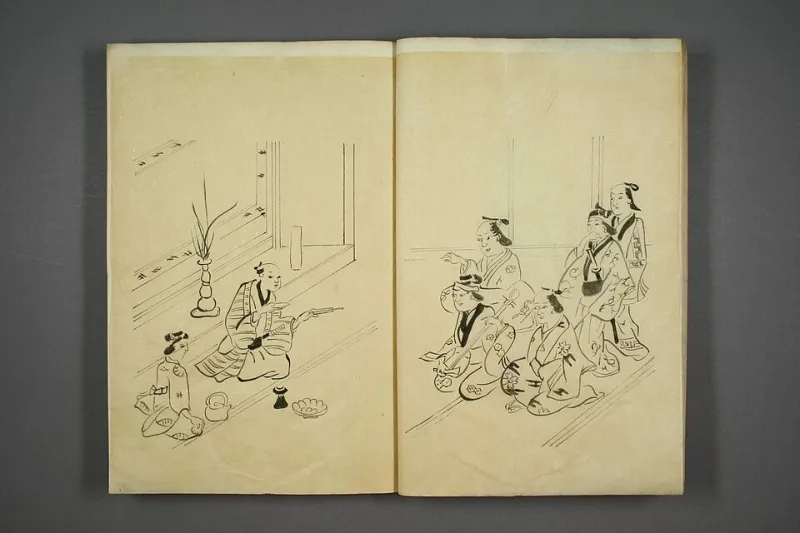
Photo: 鹿野武左衛門 作 古山師重 画, Public domain, via Wikimedia Commons
The room holds maybe forty people. There's no stage lighting to speak of, no sound system, no screen. A performer in a kimono settles onto a cushion, picks up a folded fan, and begins to speak. Within three minutes, nobody is checking their phone.
This is rakugo—a classical Japanese storytelling tradition that's been around since the 17th century—and it's quietly finding a home in American cities in ways that would have seemed unlikely even a decade ago. From community centers in Los Angeles to converted storefronts in Chicago, audiences are discovering that a single human voice, telling a story slowly and with total commitment, can do something that hours of streaming content cannot: make you feel like you're actually present.
What Rakugo Even Is (And Why It Sounds Simple but Isn't)
At its core, rakugo is a one-person performance. The storyteller—called a rakugoka—sits on stage and inhabits every character in the story using only voice shifts, facial expressions, and the occasional prop (typically that folded fan or a small cloth). There's no set. No costumes beyond the kimono. No supporting cast. Just a performer and their craft.
The stories themselves are often comedic, rooted in Edo-period Japan, full of bumbling merchants, clever servants, and misunderstandings that spiral beautifully out of control. But what strikes American audiences most isn't the humor—it's the pace. Rakugo breathes. It pauses. It lets a joke land and then waits while the room decides how to feel about it.
Kamishibai works differently but lands with similar force. Literally translated as "paper theater," it involves a performer cycling through illustrated story cards mounted in a small wooden frame, narrating the tale as each image is revealed. The format originated as street entertainment in 1920s Japan, where storytellers would ride bicycles to neighborhood corners and gather children with the promise of a story before selling candy. Today, kamishibai performances for adult audiences are popping up at Japanese American cultural events, library programs, and community festivals across the US, and they carry with them something unexpectedly moving: the sensation of being read to.
The Conversation We Forgot to Have
America has a listening problem. Most of us know this, even if we don't talk about it directly. Conversations have become competitive. We interrupt. We half-listen while composing our response. We reach for our phones mid-sentence. Podcasts have replaced silence. Earbuds signal unavailability. And yet, surveys consistently show that Americans feel profoundly unheard—by their partners, their coworkers, their communities.
What's interesting about rakugo and kamishibai is that they address this crisis from an unexpected angle. They don't teach you to speak better. They teach you to receive.
Attending a rakugo performance is a masterclass in receptive attention. You can't fast-forward. You can't rewind. You can't pause to look something up. The story arrives at its own speed, and your only job is to follow it. For many Americans, especially those accustomed to consuming content in short bursts, this is genuinely disorienting at first—and then, somewhere around the ten-minute mark, something shifts. The mind stops trying to race ahead. You stop anticipating the punchline. You just... listen.
Several Japanese American cultural organizations across the US have started incorporating rakugo workshops and performances specifically because of the conversation they spark afterward. Attendees don't just talk about the story—they talk about the experience of listening to it. What it felt like to slow down. What they noticed when they stopped multitasking. It becomes, almost accidentally, a community conversation about attention itself.
Why Live and Slow Matters More Than Ever
There's a reason these art forms are resonating right now, and it's not nostalgia. It's hunger.
Americans have more content available to them than at any point in human history, and many are quietly exhausted by it. The paradox of infinite choice is that it can make every individual thing feel disposable. You watch half an episode, move on. You scroll past a video before it's finished. Nothing quite lands because nothing quite demands that you stay with it.
Rakugo demands that you stay. Kamishibai demands that you stay. And in demanding it, they give you something back: the satisfaction of having actually experienced something from beginning to end, in real time, with other people who were doing the same thing.
That last part matters more than it might seem. The communal element of these performances—the shared laughter, the collective silence, the moment when the whole room gasps at the same beat—creates a kind of social fabric that's hard to replicate digitally. You didn't just consume content. You witnessed something together. And that witnessing changes how you relate to the strangers sitting next to you.
What Audiences Are Taking Home
Talk to people after a rakugo show and you'll hear versions of the same thing: I forgot how good it feels to just listen. Some describe it as almost meditative. Others say it made them want to call someone they'd been meaning to reach out to for months. A few have said it made them better at their jobs—specifically, at meetings, at negotiations, at conversations where they used to feel compelled to fill every silence.
That's the unexpected ripple effect of these performances. They're not just entertainment. They're a kind of recalibration. They reset your nervous system's relationship to pace, to silence, to the voice of another human being.
Kamishibai has a particular effect on parents who attend with their kids. There's something about watching illustrated cards flip slowly while a story unfolds that reawakens a childhood experience of being read to—and it makes parents want to replicate that experience at home, away from screens, with their own voices.
Where to Find These Performances
If you're curious, you don't have to travel to Japan. Rakugo performances in English are becoming more common at Japanese American community events, cultural festivals, and university arts programs. Organizations like the Japan Society in New York and various Japanese American Citizens League chapters have hosted rakugo events, and a growing number of independent performers are bringing the art form to venues that wouldn't have considered it five years ago.
Kamishibai is even more accessible—many public libraries with Japanese American cultural programming have added it to their event calendars, and it's become a beloved feature at events like cherry blossom festivals across the country.
The best way to find something near you is to connect with your local Japanese American community organization or check event listings at Japanese cultural centers. And when you go, leave your phone in your pocket. The whole point is to show up without an exit.
Something is waiting for you in that room. But you have to be quiet enough to hear it.